How Actors Interpret Stage Directions in Southern Theatre
Learn how actors interpret stage directions in Southern theatre, separating practical cues from open-ended images while keeping local voices and setting alive.
In an invented rehearsal for a community play set in a Gulf Coast town, an actor reaches “She waits by the door” and looks towards the entrance. The direction “A pause” does not say whether she listens for a passing car, studies the porch light or lets the silence settle. Interpreting stage directions in Southern theatre means noticing what the text requires while asking how its people, place and speech shape the choices left open.
A stage direction is part of a play’s written score, but it is not always a command with one correct physical answer. Some directions establish practical events; others offer an image, a rhythm or a clue about the play’s world. In Southern performance, that world might be shaped by a particular community, landscape, history or vernacular voice, but the script—not a general idea of “Southernness”—must guide the work.
Read the direction for the work it does
Before deciding how to play a direction, ask what job it appears to do. A note such as “The telephone rings” establishes an event that affects the scene. “He crosses to the window” gives a clear spatial action. “Uneasily” suggests a quality of feeling or behaviour without prescribing a particular gesture.
These categories can overlap. “She turns away, smiling” gives an observable action and an emotional colour, yet an actor still decides how quickly she turns, what the smile conceals and whether the other character sees it. The useful distinction is between what the text makes necessary and what rehearsal can discover.
- Event: A knock, blackout or entrance changes what can happen next. If removing it would make a later line or action impossible, preserve the event; if it is a flexible sound or cue, ask the director whether another clear choice serves the scene.
- Blocking: A character sits at a table or crosses to a door. If the position affects a reveal or relationship, keep that spatial fact; if it only indicates a route, adapt the movement to the playing space.
- Delivery: “Quietly” or “overlapping” shapes speech. If the note makes the words or interruption intelligible, retain that effect; if its exact manner remains open, try another delivery that preserves the text’s purpose.
- Atmosphere: “The room feels suspended” suggests a shared tone rather than one gesture. If the image clarifies the scene’s pressure, explore pace and focus that carry it; if it stays vague, return to the dialogue and choose a playable action instead of illustrating it literally.
- Local detail: A direction may name a porch, church hall, courthouse or regional sound. If that detail is explicit and affects the scene, keep it legible; if it is only an assumption based on the play’s location, do not add it without textual or production grounds.
- Safety or mechanics: A cue may involve a prop, sound or performer’s route. If the action is unsafe or impractical, stop and consult the director and venue procedure; if a safe alternative is available, agree on it before continuing.
These labels are working aids, not rigid rules. A director may find that an apparent mood note has a practical consequence, or that a named movement needs adjusting to make the scene playable.
Separate visible action from emotional interpretation
Some directions describe what an audience could plainly see: a chair tips, a letter is hidden, a character leaves. Others interpret what is happening inside a character: “She is ashamed”, “He knows he has lost” or “The silence is threatening”. An actor can use the emotional wording as a clue without illustrating it with a stock expression.
Consider “He is frightened”. One choice might make the actor tremble; another might keep the body still, make the voice unusually precise and let fear appear in a delayed answer. The direction points towards pressure in the scene. The actor’s task is to make that pressure legible through the circumstances and relationships, not to decorate the line with a preselected sign.
In rehearsal, translate an abstract note into a playable question: What does this character want to avoid? What are they trying to make the other person believe? In a Southern play, the answers may depend on a family relationship, a place-specific custom or a history named in the script. Do not supply a regional habit or accent merely because the setting suggests it.
Use the surrounding lines and setting as evidence
A direction rarely explains itself in isolation. Read the speech before and after it, note who is present, and track what changes. “She laughs” may release tension, mock a threat or cover a sudden realisation. Another character’s response can narrow the possibilities without settling every detail.
Pay attention to details the play actually gives: a named town, a work routine, a local term, a family tie or a sound that returns. If a character adjusts a cuff whenever a particular name is mentioned, that pattern may matter more than an isolated note to “fidget”. Repetition lets a small action acquire meaning, while invented regional colour can distract from the writing.
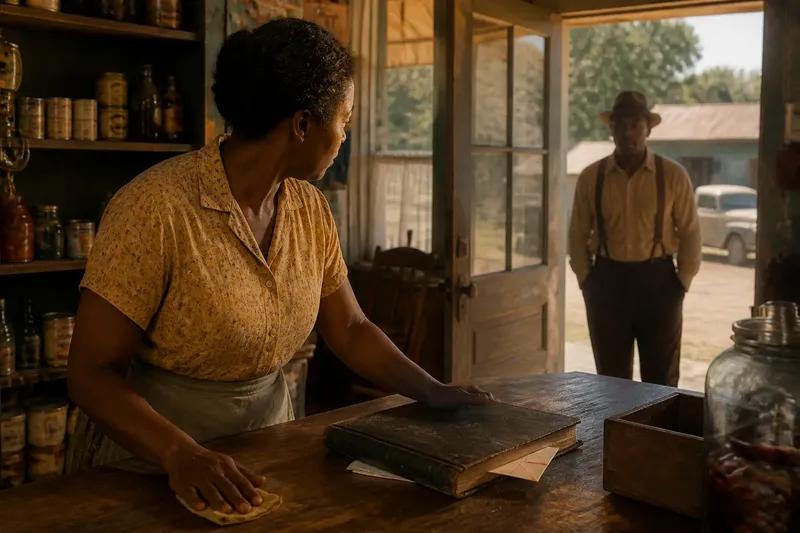
Imagine an invented scene set in a fictional Mississippi Delta shop. The starting situation is specific: a shopkeeper has hidden a folded letter beneath a ledger, and a neighbour enters to ask about a delivery. The script says, “She smooths the counter.” The actor first reads the exchange around the direction, then tries smoothing the counter while keeping the letter covered, and then tries the same action while looking towards the neighbour. In the first version, the concealment remains active without an exaggerated guilty look; in the second, the neighbour may seem to receive a deliberate signal. If the next line shows that the neighbour has noticed the letter, the first choice no longer fits, so the actor and director can revise the look or movement. The town is invented, and the choices arise from the stated scene rather than a claim about how people in the region behave.
This is a way to reason from the text, not a claim that every direction contains a hidden code. Sometimes a counter is simply a counter, and a movement is there to keep the scene clear.
What should an actor do with an ambiguous direction?
Does “pause” mean the actor must stop moving?
Not necessarily. A pause may be a break in speech, a shift in attention or a still interval, depending on the surrounding action. Try the silence with movement and without it, then judge which choice keeps the thought clear.
Should an actor follow every stage direction literally?
Begin by taking the printed direction seriously, then ask whether its exact form is essential or adaptable. A specified entrance or handover may carry plot information, while a note about manner may leave several workable choices.
Can a director change a direction?
In rehearsal, a director may explore a different action if the original is impractical, unclear or at odds with the production’s staging. For a performed script, the rights holder’s terms and applicable local rules may govern alterations, so seek qualified advice when that question matters.
What if the playwright’s intention seems unclear?
Compare the direction with the dialogue, stage conditions and the character’s immediate objective. If uncertainty remains, discuss the options with the director or, where possible, the playwright rather than presenting a guess as certainty.
Distinguish a practical constraint from a playable suggestion
A practical direction often protects the scene’s basic mechanics. If a character must leave before another speaks, that timing may preserve a reveal. If a prop is passed, dropped or concealed, the action may affect what the audience knows. A direction may also be needed for a transition, a sound cue or a performer’s safe route through the space.
Other wording is more easily shaped. “Tenderly” does not specify where the actor stands or how long a touch lasts. “The room grows colder” may describe atmosphere rather than call for a literal temperature change. Ask what would be lost if the direction were interpreted differently: if the answer is a plot fact, cue or necessary relationship, preserve it; if the wording chiefly offers tone, explore choices that honour it without copying an imagined performance.
When practical staging raises questions about equipment, sound, props or performer safety, rely on the venue’s procedures and relevant manufacturer instructions. Do not improvise around a hazardous effect or object to satisfy a descriptive phrase.
Let Southern imagery guide the choice without turning it into a rule
Playwrights sometimes write directions in images: “The room tightens”, “The words land like stones”, or “She moves as if the floor belongs to someone else”. In a play rooted in Southern cultural life, an image might also draw on a named landscape, gathering place or tradition. Its meaning belongs to the text and its characters, not to a single fixed idea of the region.
Think of an image as a paper lantern: it gives the scene a shape to gather around, but it does not dictate every step inside the light. “The room tightens” might lead to shorter exchanges, reduced movement or sharper focus between two characters. Which choice works depends on the play’s rhythm and the specific relationships on stage.
For actors, an image can become a private prompt. For directors, it can start a conversation about pace, distance and attention. For readers, it can reveal a scene’s emotional weather without requiring one definitive staging.
Keep a rehearsal record of what the text leaves open
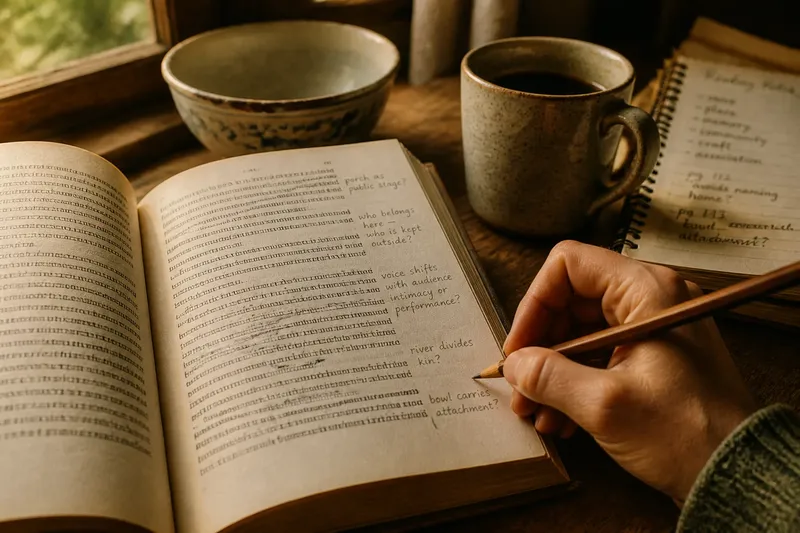
A useful rehearsal note separates the printed direction from the production’s current choice. Write “Script: ‘She turns away’” and then “Today: she turns towards the window after the name is spoken.” This distinction helps the team remember which element comes from the play and which emerged through rehearsal.
It also makes revision easier. If the scene feels unclear, the director can revisit a choice without treating it as a correction to the script. If a movement has become important to a performer’s interpretation, the team can see why it was adopted and whether it still serves the scene.
For a reader working alone, mark actions the text plainly requires separately from questions to explore. That small distinction keeps interpretation curious rather than careless, and helps the play’s particular cultural details remain distinct from assumptions brought in from outside.
Read closely and leave room for the performance
Stage directions are neither disposable decoration nor a complete map of a performance. They can establish events, protect timing, point towards emotion and give a scene a vivid image, while still leaving actors and directors responsible for pace, gesture, focus and tone. In Southern theatre, that balance also leaves room for the specific voices and cultural details a play has actually put on the page.
When you meet an uncertain direction, identify its practical work, compare it with the surrounding lines and ask what the audience needs to understand. The phrase stage directions names both sides of the task: the text offers guidance, and actors turn that guidance into a particular performance shaped by the play’s own place and people.
A script becomes more playable when its instructions are honoured without being mistaken for the only possible performance. Keep the concrete action clear, let emotional clues inform the work, and make regional context answer to the writing rather than stereotype.